What makes Neapolitan dough different
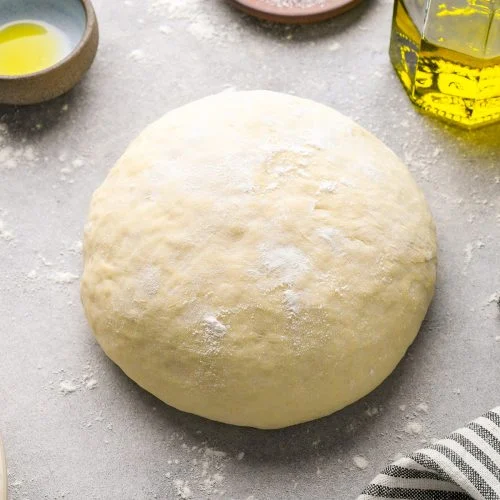
Neapolitan dough is made of flour, water, salt and yeast. That is the entire list. There is no oil, no sugar, no milk, no dough conditioner and nothing to speed it along. Everything that makes it good comes from what happens between mixing it and baking it.
The slow rise is the whole technique
We mix our dough and then leave it alone for up to 72 hours. During that time the yeast works slowly through the flour, and two useful things happen. The first is flavour: fermentation produces compounds that a fast-risen dough simply never develops, which is why a two-hour dough tastes flat and bready and a three-day dough tastes like something. The second is digestibility. Long fermentation begins breaking down the gluten and the starches before you ever eat them, which is a large part of why a properly made Neapolitan pizza does not sit heavily afterwards.
This is also why we cannot make more dough on a busy night. What we have on a Saturday was mixed on Wednesday. When it runs out, it runs out.
Hydration, and why the dough is sticky
Neapolitan dough carries a lot of water relative to flour. That high hydration is what produces the open, irregular holes inside the cornicione — the puffed rim around the edge. Steam trapped inside those pockets is what makes the rim inflate in the oven.
The trade-off is that wet dough is harder to handle. It sticks, it tears if you rush it, and it will not tolerate being rolled. Which brings us to the part that matters most.
Stretched by hand, never rolled
A rolling pin pushes the gas out of the dough. Everything the three-day rise built gets flattened into a uniform sheet, and the rim can no longer inflate because there is nothing left in it to inflate. Rolled dough bakes into a cracker.
So the dough is stretched by hand, working from the centre outward and pushing the gas to the edge rather than out of it. The middle goes thin. The rim stays thick and full of air. That contrast — tender in the centre, airy and blistered at the edge — is the whole point of the style, and it is decided before the pizza ever reaches the oven.
Ninety seconds
The oven runs extremely hot, and a pizza is in and out in roughly ninety seconds. That speed is not showmanship. It is the only way to get the rim to spring and char while the centre stays soft. Bake the same pizza slower at a lower temperature and the water cooks out of it: you get something drier, denser and evenly browned, which is a perfectly good pizza but a different one.
The dark spots on the rim are not burn marks. They are leopard spotting, and they are what a correctly fermented dough does at that temperature. If a Neapolitan pizza arrives with a uniformly golden rim and no spotting at all, something in the chain was wrong.
Why the centre is soft
People new to the style are sometimes surprised that the middle of the pizza does not hold up like a New York slice. It is not supposed to. A Neapolitan pizza is eaten with a knife and fork in Naples, or folded into quarters — a portafoglio, a wallet — and eaten by hand. Either is correct. What it is not built for is being held flat by the crust and eaten point-first.
That softness in the middle is moisture: from the dough, from the tomato, from the mozzarella. It is why the pizza is best in the first ten minutes, and why we would rather you ate it here than drove twenty minutes with it.
Made fresh, every day
We make dough every morning. Nothing is frozen, nothing is bought in, and there is no par-baked shell waiting in the back. It is the least efficient way to run a pizzeria and the only way to make this particular pizza, which is a trade our family made a long time ago and has never revisited.
What goes wrong, and how to spot it
Three failures are common enough that you can diagnose a Neapolitan pizza from across a table.
A pale, uniform rim. Either the oven was not hot enough or the dough was under-fermented. Both produce a rim that browns evenly and never blisters. A correctly made one is irregular — some spots dark, some barely coloured.
A tough, chewy rim. The dough was over-worked, usually by being handled too aggressively during stretching. Gluten that has been fought with tightens up and bakes dense instead of airy.
A soggy centre that never firms. Usually too much sauce, or a tomato with too much water in it. Some softness in the middle is correct and intentional; a base that will not support its own toppings at all is not.
Why it is a small menu
We make one dough. It is used for the pizzas and, folded differently, for the Saltimbocca. There is no separate thin-crust recipe, no deep-dish alternative, no gluten-free base made from the same process — the gluten-free crust is a genuinely different product, which is why it is a $3 addition rather than a swap.
Running one dough means we can be exacting about it. A kitchen making four different bases is dividing its attention four ways, and dough is the ingredient least tolerant of divided attention. It needs to be checked, fed and timed on a schedule that does not care how busy the dining room is.
You can taste the difference in the simplest thing on the menu. Order a Margherita — tomato, mozzarella, basil, oil — and there is nowhere for a bad dough to hide.
Hungry yet?
Neapolitan pizza, Roman pasta and an Italian deli at 2500 E Commercial Blvd, Fort Lauderdale.